

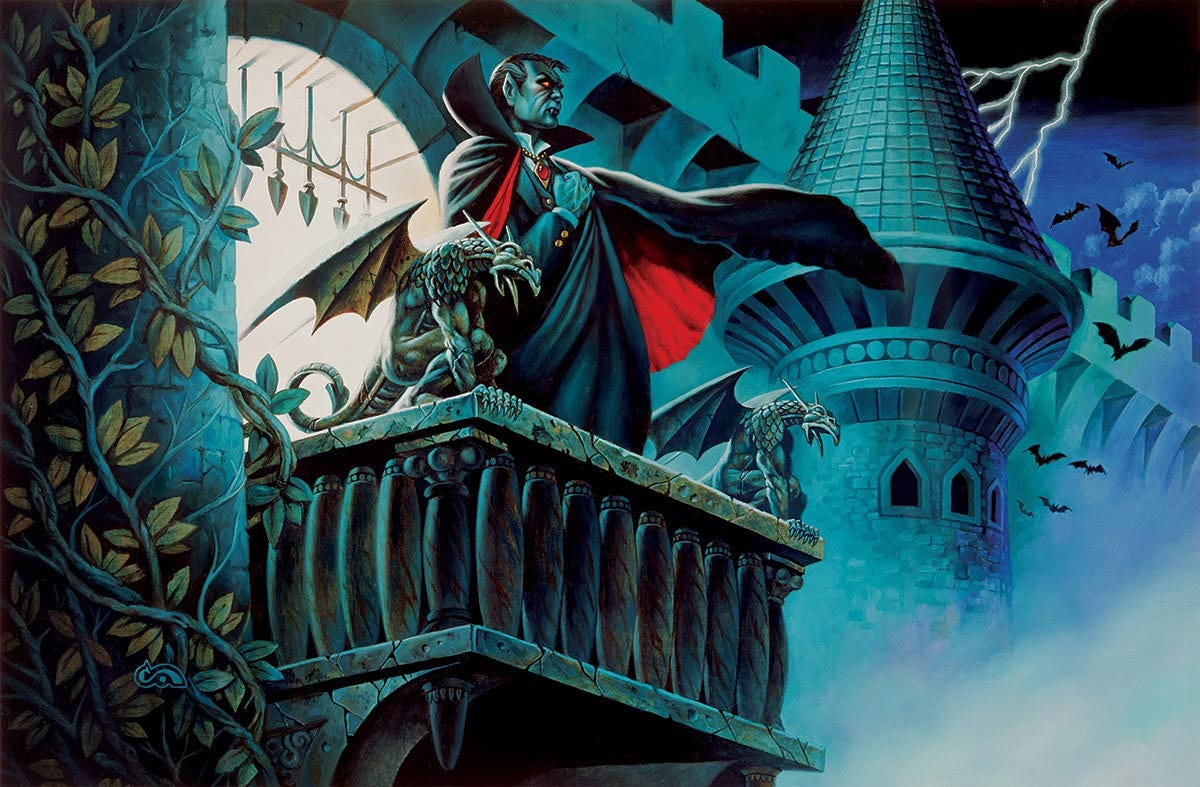
Ravenloft is one of the most seminal and beloved adventures in the history of Dungeons and Dragons. Each edition of the game has its own take on it as well as its own expansions and alterations. Ravenloft is also a scenario designed to include several touchstones of gothic horror throughout. While much of it is evocative and occasionally successfully creepy, much of it is there simply because that is what often appears in the genre. Like much of fantasy, it is done without much deliberate purpose beyond that. ACKS II is a very much a simulationist game and as such it thrives when there are specific and well-defined reasons for why things are the way that they are. The goal with adapting Ravenloft to ACKS was to bring over the scenario with much of is classic elements and flavors and see how the demands of a simulationist framework alter and enhance it. This series articles will detail the adaptation process including narrative changes, logistical demands, system specific alterations, and personal touches. All with the math and logic behind it.
Some discretions:
Firstly, it was hoped that this would have been playtested at least once before writing this article. However, there has been little opportunity to do so. As such, some of what has been done may have been ill-advised and/or not done particularly well. Consider this material at this time to be unfinished. If one those who reading this does opt to use this material in a personal ACKS game, I would love to hear how the game went.
Secondly, these articles will be written with Judges in mind, nothing wrong with a curious player also taking a look at it and recommending it to a judge but know that you are spoiling somethings for yourself in doing so, going forward it is assumed that Judges with an interest in running this at the table will be reading and have at least a basic knowledge of the rules of ACSK II.
Thirdly, Ravenloft is at its core a horror adventure. As such, there will be elements that may make some uncomfortable and hesitate to include such elements at the table, either to avoid arousing their own personal squeamishness around the subject matter or to not potentially offend the sensibilities of their players. In response, if some of these elements make you uncomfortable, then objective or instilling horror has been achieved. When agreeing to a scenario where the primary genre is horror, a certain degree of discomfort is to be expected. It is what everyone signed up for. That being said, certain elements may be a bit much for some. Near the end of the series, some potential alternative elements and considerations will be given to attempt to accommodate a few specific sensibilities. For the majority of this project, they will be ignored.
With all that being prefaced, let us begin.
How Ravenloft is made?
The Germ of this idea came from reading the ACKS II 9th level Ritual Shadeveil. More specifically, the Living Nightmare variation, which reads as follows:
”The domain is shrouded in a dismal and foreboding shadowscape. Creatures that enter the affected area are automatically affected by the shadowscape with no saving throw. Affected creatures reduce their movement by half (on top of any terrain modifiers) and reduce their visibility distance to just 30’. The magical misdirection combined with the constantly grasping, tripping, twisting landscape makes it impossible for affected creatures to succeed on Mapping, Land Surveying, and Navigation proficiency throws.
The domain is abandoned, becoming unsettled, with all inhabitants departing over a period of 1d6 months. After 12 months, the entire domain becomes a shadowed sinkhole of evil.
All animals in the domain attempt to flee. Those that are unable to flee die within 1d12 months (and might thereafter rise as undead). All normal plants slowly wither and die over 1d12 months. The dead remnants then begin to horrifically warp into bleak, thorny, and misshapen forms.
Sapient creatures traveling in the domain can find themselves unknowingly diverted away from the nearest exit. Each creature must make a Spells saving throw every hour. (If the creatures are traveling as a unit, roll once for the unit as a whole using the unit leader’s throw.) If the save fails, the creature(s) or unit spends the hour wandering in circles with no sense of direction.
A sense of hopelessness, fear, and misery affects the minds of those within. Whether traveling or stationary, each sapient creature in the domain must make another Spells saving throw every hour. If the save fails, the creature suffers one of the following effects (roll 1d12):
1-2: The creature suffers a living nightmare in which it is “killed.” The creature must make a Death saving throw. If the save succeeds, it becomes slumbering for 1d12 rounds. If the save fails, it becomes slumbering for 1d12 hours.
3-4: The creature experiences a traumatic event, either a real vision from its past or an imagined event that plays into its worst dread. Grief and misery root it to the spot, leaving it cowering for 1d10 turns.
5-6: The creature experiences a waking dream in which it is beset by enemies or terrible beasts. The creature becomes infuriated and immediately attacks the closest sapient creature (usually an ally) and continues to do so for 1d10 rounds before coming to its senses.
7-8: The creature encounters one of its worst fears, causing it to become frightened for 1d10 turns. The creature will run in a random direction, believing itself to be relentlessly “pursued” by the illusion.
9-10: A wave of exhaustion overcomes the creature. T he creature must make a Death saving throw. If the save succeeds, the creature becomes fatigued for 1d6 turns. If the save fails, the creature is slumbering for 1d10 hours.
11-12: A random encounter appropriate to the terrain is triggered. Combat ensues but the creatures are illusory, disappearing when hit. Damage sustained, however, remains.
Sapient creatures slain in the domain become haunts (see ACKS II Monstrous Manual).
When the ritual is cast, the caster can decide who, aside from himself, will be unaffected by the ritual in either form. This decision is permanent for the duration of the ritual. If the caster chooses, he can craft special talismans which ward off the ritual’s effects on whichever creatures carry them. Crafting a shadeveil talisman has a material cost, component cost, and research cost of 500gp.
Once complete, the ritual lasts for 12 months. However, the caster can extend the ritual duration by linking the shadeveil with the life force of a living creature.
…
In the case of a living nightmare, the caster can designate a living creature to become the cursed victim of the nightmare. The creature does not have to be willing, but it must be magically put to sleep (usually by slumber or deep slumber) in order to become the cursed victim. Once asleep, the victim enters into a perpetual nightmare that slowly consumes their soul. Each year that it slumbers, the victim ages 1d10 years. If the creature dies, it becomes a specter doomed to haunt (and sustain) the domain. A shadeveil can be dispelled by a remove curse spell by a higher level spellcaster than the creator of the ritual. Alternatively, the shadeveil can be dispelled by removing or killing the guardian of the secret veil, waking up the victim of the living nightmare, or destroying the specter the victim has become. A wish or miracle could also end the ritual.”
Pretty gnarly stuff. If we assume that the mists of Ravenloft, which in all previous editions have been a fairly ill-defined and nebulous thing is instead a living nightmare shadeveil, things become much more brutal for both the inhabitants and adventurers, and it also wildly changes the social and logistical dynamics of Barovia in many drastic ways. Before we begin to define those, let us get a feel for the land of Barovia.
Which version of Ravenloft?
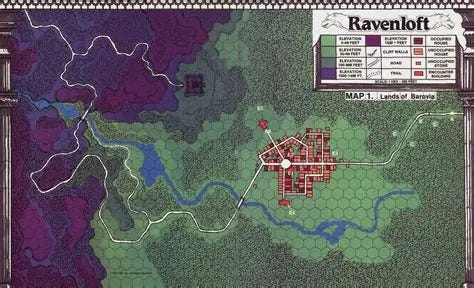
The original I6 Ravenloft is the standard by which all others are judged. Sadly, it is not suited for our purposes. Simply put, it is too small, I6 only contains the village of Barovia and the Castle. Shadeveil covers a 24-mile Hex, and if Strahd Von Zarovich is indeed a Count in ACKS terms, then is reasonable to assume that his land and holdings could and should cover a 24-mile hex. So, we need to think bigger.
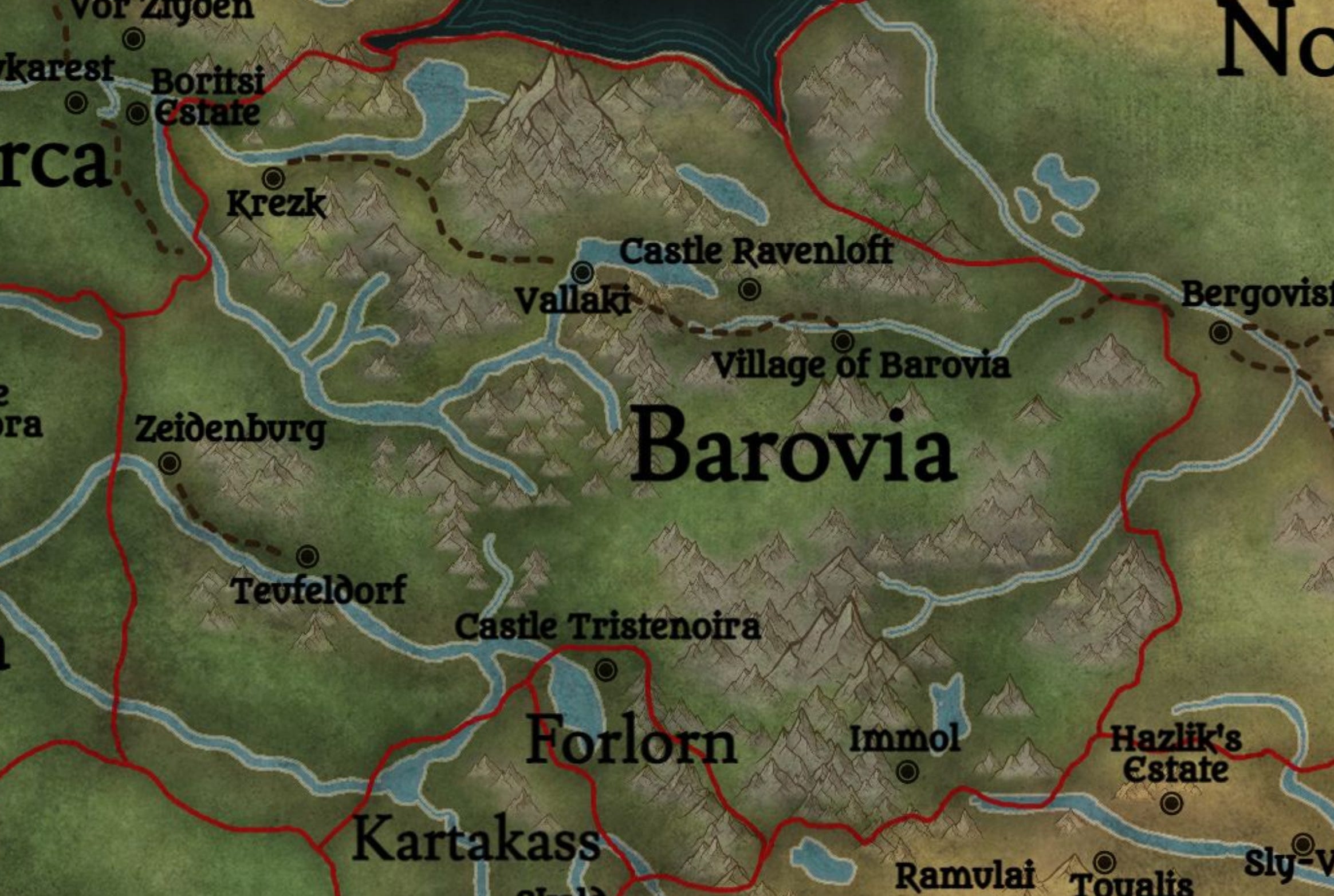
Next, we look at AD&D 2e Ravenloft which is better, we have another larger town in Vallaki and several other towns that are shown on the map but aren’t detailed in a meaningful way in the text. There is more land as noted on the map, alas there still isn’t enough detail here for our purposes. We want to make the full use of the 24-mile hex that we have to play with. We could play around with the other demiplanes of dread, but as Ravenloft was a standalone originally it is preferable to limit our scope to Ravenloft alone. Keep that stuff to implications that we can place later. Which make the only logical choice…
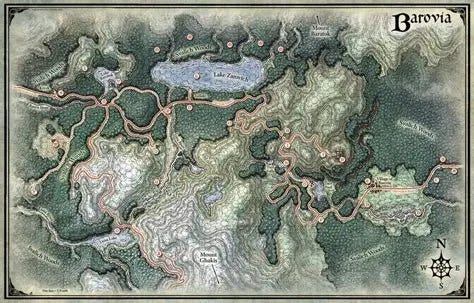
5e D&D’s Curse of Strahd. A conclusion that shocked me, but when looking at the landscape it makes perfect sense. Three towns and a fourth one which is destroyed in the normal adventure which we can revive for our purposes. All with distinctly different logistical and social situations which give rise to unique problems in each town, giving each its own tale of woe. A few extra dungeons where we can have other unique optional encounters, loot, and treasure that players can gather to help themselves, and they allow us to expand on the narrative of Ravenloft in fun and unique ways. It is the natural choice. Now that we know the lay of the land, we have to ask ourselves a question. How does anyone live here?
How to survive when nothing grows and you can’t leave.
Let’s call attention to the first three bullet points of the ritual.
The domain is abandoned, becoming unsettled, with all inhabitants departing over a period of 1d6 months. After 12 months, the entire domain becomes a shadowed sinkhole of evil.
All animals in the domain attempt to flee. Those that are unable to flee die within 1d12 months (and might thereafter rise as undead). All normal plants slowly wither and die over 1d12 months. The dead remnants then begin to horrifically warp into bleak, thorny, and misshapen forms.
Sapient creatures traveling in the domain can find themselves unknowingly diverted away from the nearest exit. Each creature must make a Spells saving throw every hour. (If the creatures are traveling as a unit, roll once for the unit as a whole using the unit leader’s throw.) If the save fails, the creature(s) or unit spends the hour wandering in circles with no sense of direction.
These three points paint a pretty grim picture of the place. In fact, per RAW Barovia has been dead for a while. However, here is where we need to break from RAW and ride along the spirit of the rules instead. Let us look at these points as what much of the rules in any system are, ABSTRACTIONS. These are abstract representations of longer and more in-depth processes that happen over the course of months. Let’s zoom in for a second and walk through what happens.
The domain is abandoned completely after 12 months. Why? Because for 1-6 of those months, everyone is leaving. Well, why are they leaving? Because the shadowscape is blocking out most of the sunlight and stopping plants, including their crops from growing. This in turn means that most of the animals that rely on that plant life are also dying because they can’t get enough food. So they leave, why is anyone here? Because they can’t leave. Barovia is mostly Forest, Taiga or Mountainous terrain which means you travel at 2/3 speed and the living nightmare further halves that. So if you’re picking up your life and trying to leave you’re are probably quite significantly laden down. Which means you have quite the slow crawl out of Barovia ahead of you. Then consider that the vast majority of NPCs in ACKS(including most all peasants) are level 0, this means level 0 Saving throws. Each creature has to make a spells save or be diverted away from an exit. Given how slow you already move that could mean spending a full day wandering in circles inside the fog just end up back where you started with less provisions, and virtually no way to get any more. Considering most people on Barovia don’t live anywhere near a border, and there is a 90% chance of getting spat back into the hell-hole you're trying to leave. For most Barovians, it isn’t worth the risk to try to leave. So how do they live in this place if they can’t leave. Religion.
The Power of Prayer and Population Size
AD&D 2e’s Ravenloft setting guide puts the population of the village of Barovia at approximately 500 people and 1500 for Vallaki, making a total of around 2000 people for the county. Yes, it makes reference to smaller settlements but doesn’t name them or detail them in any way, so for our purposes they don’t exist. A typical County in ACKS has around 3,600 -10,000 families, a family in ACKS is 5 people (Mother, Father, three children), that means the population of a normal county is between 18,000 - 50,000 people. Needless to say, Ravenloft’s population is much too small. So we have to increase the population of Barovia.
Given that the Village of Barovia lies in Ravenloft’s shadow, it is safe to call this Strahd’s personal domain. For a typical Count, that is around 780 people, so let’s set the village’s population to that number. Next is Vallaki, it is supposed to be the capital settlement of Barovia so let’s make it a “Small City” and put it on the higher end, 2200. Next, we have Krezk which is supposed to be another smaller city, so another “Small City” this time on the smaller end, 1500. Finally, the town of Berez, abandoned for some time it is finally having some life brought back into it. It has a pitifully small 200 families. The reason for these specific numbers are for both congruence with ACKS numbers and for subsistence.
Religion plays a big role in Ravenloft, not for mere matters of community and guidance, but because belief is literal survival. In the section of the ACKS II rules that talks about “Congregants and Divine Power” it gives information about how divine casters can generate divine power from their congregations and use it for other purposes. The two we will concern ourselves with are “Consecrating Altars” and “Consecrating Fields”. Altars, depending on their size, can create areas that are considered Pinnacles of Good or Sinkholes of Evil. Each of the cities will have a Church with an Altar creating an Illuminated Pinnacle of Good. This can act as a place of respite against the worst of the mental effects of the shadowscape that would be constantly plaguing the inhabitants of Barovia. Next is consecrating fields. Per RAW it states that it simply increases the land value of the fields by 1 GP for the next months revenue collection. Again, we are deviating from the rules slightly and once again looking more at the spirit of them. If the use of divine power can increase the yield of Crops, it also stands to reason that perhaps it can be used to stave off the effects of a sinkhole of evil or indeed the shadowscape they find themselves in. So that is what the people on each of the towns do. They pray often for mental respite, and to generate divine power for their Priests so that they can consecrate the fields and keep the crops growing.
Using Barovia as an example:
If we assume all 780 families go to church regularly. That is a congregation of about 3,900. As the rules state we generate 10 GP of Divine Power (DP) per 50 congregants which gives us 780 Divine power. 2GP of divine power is spent for every families worth of fields consecrated which means we only feed about 390 families or 1950 people. Except the situation is even worse. It would be unrealistic for all the residents of each town to have near Job-like level of faith. People lose their faith in the face of overwhelming adversity quite often. So let us assume 10% of the population is “faith broken” or not meaningfully contributing to the generation of divine power due to a lack of faith, the math becomes 702 or 3510 people generating 702 divine power and therefore only feeding 351 or 1755 people. As I hope is evident, this is not enough. What now? Now they hunt.
Priest, Crusaders, and any studious divine casters most will be able to learn the spell Purify Food and Water, this spell is critical to the land of Barovia. Since only so much of the crops can be kept going the rest of the families have to hunt. But what do they hunt when all the animals have died. Zombie animals. The entire county is a Shadowed Sinkhole of Evil All things in a sinkhole of evil have a chance each season of rising from the dead. The vast majority of the animals in Barovia are zombie animals, a live animals are a rarity and a delicacy. What is done is that each day hunting parties go out into the woods in groups and try to find zombie animals of any kind. When they do find one, they kill it if they can and bring its rotten carcass back to town and have a priest purify the meat so that it is safe for consumption. Given the underlying math of subsistence this works out to each parent and the eldest child of each household needing to go out and try to hunt. Given this reality, it is very likely most Barovians would have the Survival general proficiency in order to increase their chances of finding them. If we factor their hunting as parties and not being able to go very far from settlements due to the difficulty of travel we get about a 30% rate of success thus the need to have so many people hunting. But as always there are good times and bad times, so what do they do when they cannot keep up with their food requirements or simply need other things besides food to get by. They trade with the Vistani, whom we will address in the next section.
Before we finish this section, lets round off by talking about the demographics of leveled characters in Barovia. In Barovia, there are generally 3 kinds of levelled characters that are the most practical. Priests, Crusaders, and Explorers. Priests since their extra power helps keep the towns alive and in relative good health, Crusaders to act as guards and defenders against various undead creatures and the occasional evil doer(when they can), and explorers since everybody hunts, some get very good at it and become half decent combatants in the process. These are the kinds of henchmen that you will most likely have in the towns, not to say that there can’t be others especially where notable named characters are concerned, but generally these are what can be found.
Here is the full math for the demographics and subsistence of each of the towns:
Barovia: 780 families,
4th level characters: 1 Priest
3rd level Characters: 1 Priest, 1 Explorer, 1 Crusader
2nd level Characters: 3 Priests, 3 Explorer, 2 Crusaders
1st level characters: 8 priests, 7 Explorer, 5 Crusaders
32 leveled characters, 3,868 commoners
702 GP of Divine Power /2 = 351 families worth of fields consecrated
1755 farmers/ 1933 remaining
397 hunters- 397 possible stones of meat x 6= 2382/5 476.4= 476 families fed
476 x 0.3 = 143 families fed
143+351 = 494
783 hunters- possible stones of meat x 6= 4698/5 = 939 = 939 families fed
939 x 0.3 = 282 families fed
282 + 351 = 633
1169- Possible stones of meat x 6 = 7014/5= 1403= 1403 families fed
1403 x 0.3 = 772 sufficient math for survival. Can be explained by trade with the Vistani, deals with the Hag of the Old Bonegrinder and variance in success rates
The two parents and the oldest child in each family hunt
Vallaki: 2200 families
5th level: 1 Priest, Thief, 1 Chaotic Paladin(?)/ Warlock(?)/Priest(?), 1 Bard
4th level: 1 Priest, 1 Hunter, 1 Crusader
3rd level: 3 Priest, 3 Explorer, 3 Crusader
2nd level: 8 Priest, 8 Explorer, 6 Crusader
1st level: 21 Priest, 20 Explorer, 14 Crusader
93 leveled characters, 10,907 Commoners
1980 GP of divine power/2 = 990 families worth of farmland = 4950 farmers
4363 hunters x 6 = 26178/5 = 5236
5236 x 0.3 = 1570
990 farmland + 1570 meat
2560 food
The two parents of each family hunt
Kresk: 1500
4th level: 1 Priest, 1 Warlock
3rd level: 2 Priest, 2 Hunter, 1 Crusader
2nd level: 6 Priest, 5 Explorer, 4 Crusader
1st level: 14 Priests, 13 Explorer, 9 Crusaders
58 leveled characters, 7442 commoners
1350 worth of divine power
675 families worth of farmland = 3375 farmers
2440 hunters x 6= 14640/5 = 2928 stones of meat
2928x 0.3 = 878 stones of meat
878 + 675 = 1553
Two parents and the oldest child of each family hunts
Berez: 200 families
1st level: 5 Witch
6th level: 1 Witch
6 leveled Character, 994 Commoners
180 gp worth of divine power
90 families worth of farmland = 450 farmer
109 hunters x 6 = 653/5 = 130
130+90= 220
The Stagnant Corpse of Economics
The economy of Barovia would be largely stagnant if not for one element, the Vistani. The Vistani are a nomadic people who are owed a life debt by the Count as such he grants them Talismans that allow them to pass through the mists, something he himself cannot due, and something most others cannot do either. This singular fact means that the Vistani are the economy. There isn’t one without them, they know this and exploit it. Being the only ones that can leave means that they are the only ones who can bring in goods from the outside world that cannot be produced locally or can’t be produced in sufficient numbers, like food. Those who paid close attention to the math of the Village of Barovia will see that they are just under subsistence level. They make up for this with regular trade with the Vistani. The Vistani exploit this by asking ludicrous prices and demanding other forms of payment aside from coin. Krezk and Berez are slightly above subsistence so they begrudgingly trade as they need to. Berez refuses much of the time since much of the town is helped by witches and those seeking to escape Vistani exploitation. Vallaki is the standout since their position is so strong they can actually say no to the Vistani if they want and can keep them out if they so desire. At least that is what they think. The Vistani are, and should be run as a criminal syndicate, with Strahd as the leader of them. While yes, they do make trade ventures within and without Barovia, when one the outside they perform hijinks on behalf of Strahd. This is how Strahd maintains and grows his wealth despite being largely cut off from the world. The three major settlements in Barovia should have hideouts for the Vistani. At least one branch will be there in force, while one or two others may be away on ventures or hijinks. This helps create an economic loop that looks something like this.
Strahd pays his all his expenses as the ruler of the domain. Much of the money paid towards the upkeep of the settlement ends up going to the Vistani who then use that same money to pay their tributes to Strahd. The Strahd also gets his cut from hijinks that make money. This means all the money that does flow in Barovia largely flows back to Strahd one way or another. He then uses this money largely for magical research. The hijinks that are done by the Vistani are also how adventurers are lured here, and the economic and research incentives provide the why. While in normal Ravenloft Strahd brings adventurers in as playthings to torture for no understandable goal. Now, Strahd lures them in through the Vistani because mid-level adventurers are likely to have expensive equipment and magic items that can either be sold to add to his coffers or recycled into magical research projects.
Social Dynamics of Desperation
Now that we’ve established what the situation of everyday living looks like, what are the social dynamics of Barovia. In short, they are not fun. Due to the need to hunt and leave the safety of the nearby church and the help of the priests. Mental illness runs rampant. Paranoiac, Anger Management Issues, Narcolepsy, and Schizophrenia are fairly commonplace. In fact, it could very well be that the explorers in each time may very well be some of the worse sufferers of these afflictions since they are the best at being outside the walls. These are also often treated by other spells of the priests that can help alleviate or protect from mental afflictions. Speaking of Priests, all Barovians are deeply religious because to not be is to allow not just yourself, but everyone else to be swallowed by the darkness surrounding them, they are also generally speaking a hardy folk due to the necessity that over half of them be hunters who have to feed themselves and others so they are likely tougher than most average villagers. This combined with the fact that this situation has been the reality for Barovia for at least 400 years means that the Barovians are a hardy and grim mannered people, many likely have a fatalistic outlook on life in spite of their religious beliefs. There are some notable exceptions to this rule namely the Burgomaster of Vallaki, but that will be described in detail in another article. Barovians are also largely distrustful of outsiders, this is in large part due to their interactions with the Vistani.
Strahd plays at still being a good ruler, paying the necessary expenses of running his domain but that is where his rulership ends. His real focus comes from issuing orders to the Vistani, whom are all too glad to carry them out. Both the Vistani and the Barovians know that the Vistani are the favored people due to the life debt that Strahd has for them and due to how useful they are to Strahd. The very fact that the Vistani can leave when nobody else can gives the Vistani so much power, and the Barovians hate them for it. The additional fact that they have to rely on them for trade and survival makes them hate the Vistani even more. On the Vistani’s part, they are very much the standard persecuted nomads that Romani Gypsies have been and, in some cases, still are in our world. However, in Ravenloft the script is flipped, and they are the ones with all the power and the Vistani exploit that fact. They take liberties with the townsfolk, overcharge for goods knowing they need them to survive to enrich themselves, and demand…other payments which I will leave to the imagination for now. Just know that if it is something that someone in the Vistani’s position might demand in exchange for goods, the Vistani have demanded it at one point or another. And despite the dreary atmosphere of the place, the talismans shield them from the worst of the effects of the place, so they live largely unburdened apart from the food situation. Many of the wealthier Vistani also run businesses and own large homes for stabling their animals, storing cargo, and resting separately from the townsfolk who hate them. Many Barovians secretly wish to destroy or seize these homes and businesses or to steal their talismans. Most are too frightened to do so, harming any one of them could very well invoke the ire of The Devil Strahd. It is extremely rare for anyone, even leveled characters, to take the risk.
Moving on to more specific settlements. Since the village of Barovia is beneath their subsistence rate, they need to rely on the Vistani for survival. They are exploited the most by the Vistani. In addition, one encounter that has been kept from Curse of Strahd are the hags of Old Bonegrinder, though they are reduced to just one, since otherwise it would be far too difficult to deal with and it could take the focus away from Strahd. The reason being that since hags count as 9th level witches it means they have access to the 5th level spell “Create Food”. As such, the villagers occasionally petition the hag for their survival, especially when they are unable or unwilling to pay the Vistani’s prices. The hag usually demands payment from “virile young men” the younger the better. Sometimes they come back and other times they don’t. Some would argue they never come back either way, as the ones that do are never the same.
Vallaki is in the best position as it is well over its subsistence rate. Because of this, they only have to send out adults from each non-producing household, not the children. This is the justification behind the burgomaster’s toxic positivity and claims of one day outlasting the mists and escaping The Devil Strahd. While the Vistani do have a hideout there, it is weak and they aren’t able to exploit them as much as they’d like. They have even been kicked out on occasion, but they are usually let back in when they have exotic foods, tools, books, or other necessities and creature comforts from the outside.
Krezk is slightly above subsistence level, so they still need to trade on occasion, but they are largely unremarkable in this area. Its more unique aspects will be delved into later.
Berez is the smallest town and is run largely by Witches and Witches in training. The women learn the practical skills that are largely missing in Barovia while the men hunt. They only trade with the Vistani when absolutely necessary. Part of why they are so far away from everything is to avoid their exploitation. It is also for this reason that they remain small.
That is about all the foundational work covered. In the next article, I will detail the various narrative changes that have been made for and because of ACKS II. Including the First Vampyre himself.
Really interesting! I quite like the idea of a syndicate unassailably hidden within a Shadeveil, that's a really cool setup for outside hijinks as well. And it naturally hooks back in if you kill an operative and take his talisman. I do think the talismans would have to be pretty tightly controlled, even most of the Vistani probably don't have their own, just access to one they could borrow as needed or the like; 1150gp each effective value is considerable.